
How We Get Supplements Wrong
The supplement ignoramus with expensive urine is a hackneyed fallacy. But that hasn't stopped some critics from wheeling it out when the need arises.

The marketing trend of ‘everyday people’ building personal brands, amassing large followings on social media, and monetizing through sponsored content, endorsements, and partnerships emerged in the early 2000s, but truly exploded in the 2010s.
Welcome to ‘the influencer revolution.’
It’s not new. Back in ancient Rome, gladiators endorsed products via billboards or public appearances. In 2019, the term influencer was officially added to Merriam-Webster. Influencers come in all shapes and sizes, from small to moderate audiences in the low thousands to mammoth, billion+ world communities. Interestingly, the term ‘influence’ is an astrological term from Old French influence meaning ‘the emanation from the stars that acts upon one's character and destiny.’ The idea of the ‘exertion of unseen influence by persons’ is from Medieval Latin of the 1580s, such as from the works of Thomas Aquinas.
I’m more interested in studying its logical opposite: how can an ethical expert gently let an audience down from a widely held, if inaccurate, assumption without devaluing their interest, enthusiasm, and curiosity, and then rebuild the edifice of thought on a bigger, better basis?
In short, how to be an honest and helpful reinfluencer.
Now, some may say that this role has long been effectively occupied by skepticism, and to a significant degree, this may be true. However, in the media age, skepticism as a ‘thing’ has lost much of its independence, especially when it comes to medicine and health care. Too often, skepticism has been a tool used to silence opposing viewpoints that are unfortunate enough to get in the way of business and politics.
Skeptics themselves are not immune to their own biases; the Dunning-Kruger rule applies equally to all: the less we know, the more certain we are that we know it. Also, a lot of skeptics seem to enjoy getting into schoolyard-level imbroglios, which do nothing but devalue and alienate the very audience that could just as easily have been reformatted to integrate new knowledge into their existing worldview.
One particular vexing tendency of healthcare skeptics is the reflexive use of the ‘not invented here’ and the ‘can anything good come from Nazareth?’ jingoisms. In simpler words, they are implying, if X was important and true, I’d have heard of it already.
Now I’d like to take this moment to re-influence you on the wonderful world of nutritional supplements.
A common skeptic gambit is to rail against ‘supplements’ in the abstract, promising only depleted bank accounts and expensive urine. However, when the vaunted double-blind, placebo-controlled study suddenly shows efficacy for a specific supplement in a particular scenario, they pivot and proudly proclaim that they have always been interested in the substance, and the studies have merely verified their own intuitions about the product. This conveniently misses an important point: that said supplement was probably given the opportunity to be studied because popular consumer demand was driving interest.
Another favorite target-in-abstract is the supposedly unregulated nature of the supplement industry. Now. I’ll confess that I run a somewhat unprofitable supplement company that I created to produce some arcane nutriceutical products for my patients back when I was in practice. So I can tell you firsthand about how unregulated we are.
I had to spend countless hours building an automated product recall system to handle customer complaints. This system had to be multi-level, extending from watchfulness to customer contact to a full physical recall. This system had to be demonstrated in real time. Now, I’m an old Perl programmer, so conceiving and implementing this system was easy, and we were directly cited in the FDA report as having an exemplary recall system.
Another gripe about the supplement industry is that the products are not regulated with regard to ingredients and can have dangerous additives, pharmaceuticals, and other naughty bits. Now, this is likely true because stuff comes in from around the world, and I doubt that the regulatory agencies check it all. However, I can comment on what it’s like to make a supplement in the United States. Manufacturing is done according to GMP (good manufacturing practices) standards. Before raw materials are inventoried, they are tested for bacterial contamination and Prop 65-restricted heavy metals. Once the product has been bottled, the label is constructed according to FDA guidelines, the ubiquitous ‘supplement facts box.’ The FDA and FTC, by the way, constantly monitor our website content for unsubstantiated claims.
Now, every year or so, a pleasant Gen-Xer in an FDA windbreaker will show up unannounced and run through all FDA-required protocols and warehouse conditions, such as vermin protection and temperature and humidity control. Finally, they’ll pull out our three or four brown lunch bags and, somewhat arbitrarily, grab several products to take to their labs for analysis. Woe unto you if that product’s stated ingredients are not within the predicted range. Little-known fact: your product can have up to 10% greater levels of a particular ingredient. Actually, the FDA likes that, because a product with a two-year shelf life will slowly lose efficacy, and this ensures that a product sold towards the end of its shelf life still has sufficient levels of the ingredient.
All of this compliance, despite its great intentions, costs money. Couple that with supply chain issues that have raised raw materials prices to the ceiling, and the two have squeezed ethical manufacturers hard. One solution many adopt is enshittification, where product quality is gently eased downward, either by tweaking its makeup or cutting back on serving size. The iconic Hershey bar is famous for expanding and contracting its size in response to economic conditions.
Lacking this level of internal nefariousness, we opt for the more brutal choice: to maintain standards and let market costs drive prices. That eases us out of the competitive market, since any ‘supplement’ can have its corollary easily found on Amazon for a fraction of our price. But we are more fortunate than most. Our customer base knows our commitment to quality, and they are fiercely loyal. Funny thing is, over the years we’ve not grown much, but our user base is remarkably loyal, often for decades, a fact that amazes every analyst whose every looked at the company. Still, I feel bad that these wonderful customers must bear the increased costs.
I can’t, nor even would, vouch for the ‘supplement industry’ as a whole. God knows, I’ve met some swarmy people, many of whom would have paid me large sums of money to work alongside their get-rich-quick schemes. Thankfully, my nature is far too ambivalent for that; I cannot easily manufacture breathless, bubbly excitement; I’m far too crotchety and contrarian.
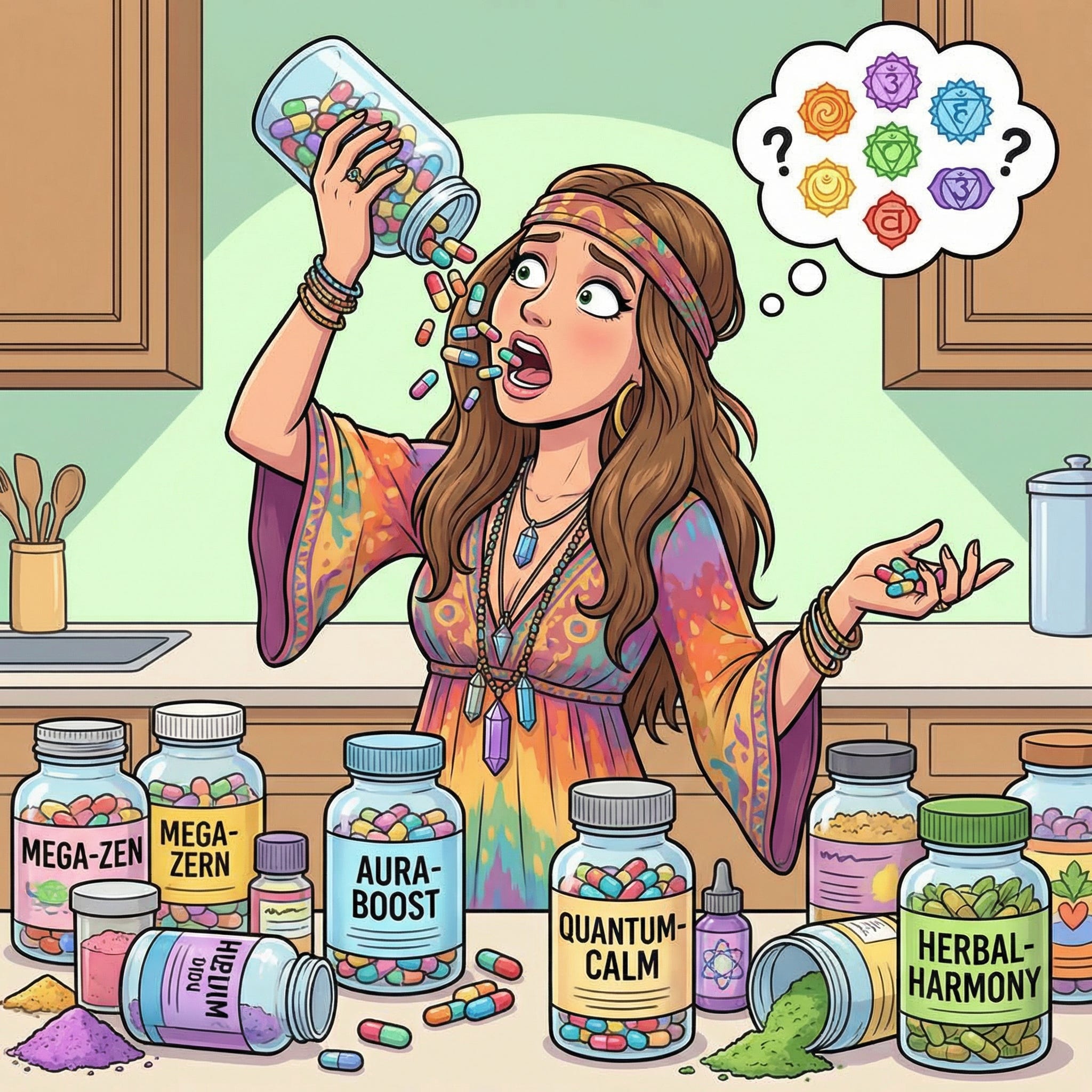
Do some people take mouthfuls of supplements just to keep the elephants off their front lawn?
Very likely, and these folks are the exact audience that needs to be re-influenced toward a more discreet use of these products, preferably under the direction of a professional. However, judging by the responses on social media to claims that this pill-popper is the target audience of the supplement industry, I have to say that this community is likely rather small and shrinking. The much larger populace of supplement users is employing them in a dedicated, rational manner, often by evaluating the same research sources that skeptics genuflect to.
But here’s the rub: apparently, there are lots of fake Louis Vuitton luggage, Rolex watches, and Chanel pocketbooks. Does that imply we should stop making the real, genuine ones? There are people who are okay knowing that the watch on their wrist is fake, and there are others who will only settle for the real thing. I realize that a fake handbag will likely not kill someone, and a supplement with a dangerous ingredient likely will, but that is why we have regulatory agencies, apparently even for counterfeit luxury goods.
I am a scientist. The FDA is not my enemy. In fact, they’ve treated the staff and me with the greatest respect, providing generous guidance on how to improve as a manufacturer.